Hello, my name is Ashley, and I love hiking and backpacking gear.
I love gear… and I love watching videos about gear, which makes me want more gear. It’s a cycle. A very expensive cycle.
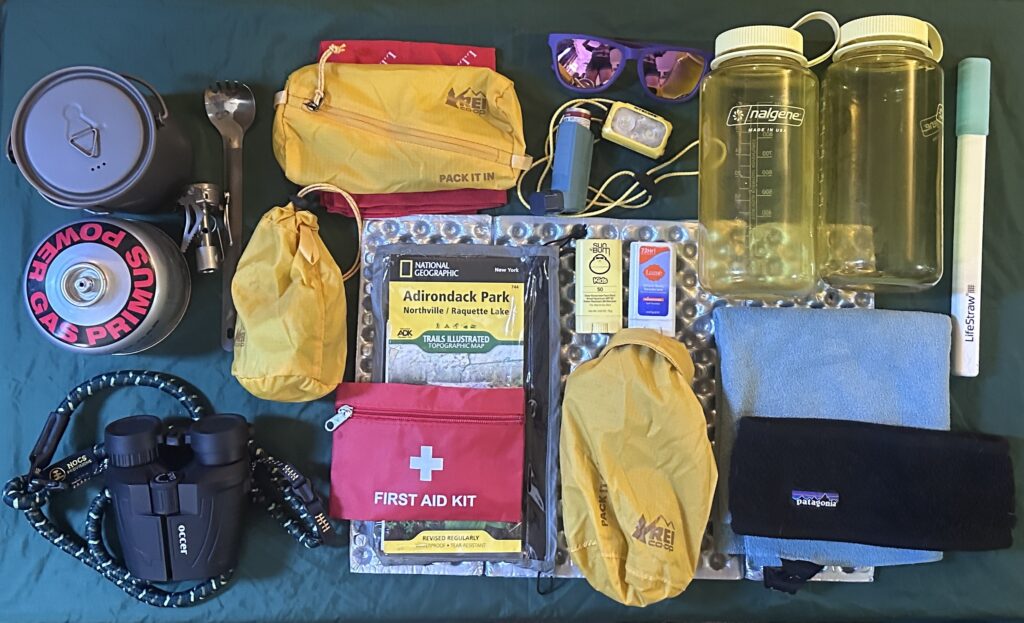
Welcome to the first installment of my hiking gear series — The One With All The Hiking Gear. In this series, I’ll be sharing the gear I use, why I chose it, how I use it, and whatever other random thoughts I have along the way. Because if there is one thing hikers love almost as much as hiking… it’s talking about hiking gear.
You can also check out my full gear list on LighterPack here.
If you’ve done any sort of hiking research, you’ve probably heard about the 10 Essentials. These are the items that are recommended to carry with you into the backcountry, regardless of whether you are heading out for a short day hike or a multi-day adventure.
In my opinion, these are non-negotiable.
Several of these items I even have duplicates of — one set lives in my day hiking pack and another lives in my backpacking bag. That way, whether I’m heading out for a quick afternoon hike with Hudson or spending a few nights in the backcountry, I know I have the basics covered.
The 10 Essentials are:
- Navigation
- Sun Protection
- Insulation
- Illumination
- First Aid
- Fire
- Repair Kit & Tools
- Nutrition
- Hydration
- Emergency Shelter
So, let’s talk about what I carry.
Navigation
I always research my hikes ahead of time. (I have an entire bucket list of hikes and challenges, so research is kind of part of the fun!) I use apps like AllTrails, maps, guidebooks I’ve collected over the years, and good old Google.
Pre-trip research helps me understand what I’m getting myself into — where the trail goes, how difficult it might be, and what challenges I might encounter. That being said, I always keep in mind that not everything you read online is accurate. Trail descriptions are subjective, and one person’s “easy mile” can feel like 25 miles on another hike.
When I’m actually on the trail, I always carry both manual and electronic navigation.
For traditional navigation, I carry a compass and a topographic map (usually National Geographic) of the area I’ll be hiking in. I will often photocopy sections of guidebooks, make notes from my research, or print additional maps that zoom in on the specific area I’ll be exploring.
For electronic navigation, I do still own a Garmin eTrex 20, which I have used in the past. However, my current favorite setup is my iPhone 14 Pro paired with onX Backcountry.
Because I rely heavily on electronic navigation, I always carry a charging cord and a battery bank. A dead phone is not exactly helpful when your phone is also your map!
Sun Protection
I am fair-skinned and have red hair, so I have two strikes against me when it comes to the sun.
Because of that, I carry several things to help protect myself:
- A trusty ball cap
- A sun hoodie
- Sunglasses
- Sunscreen (my preferred option is a sunscreen stick because it’s easy to apply on the trail)
The goal is to enjoy the views — not become one giant sunburn.
Insulation
Josh often says I’m the only person who can be cold in August… and honestly, he might be right.
I am almost always cold.
Because of that, I always carry extra layers. Even in summer, temperatures can change quickly in the mountains, and being prepared is worth the extra weight.
Right now, my summer insulation setup includes:
- Patagonia Capilene Air Hoodie
- Either a Patagonia Better Sweater or Patagonia Nano Puff Insulated Jacket (depending on the weather forecast)
I would much rather carry an extra layer I don’t need than wish I had one when the temperature drops.
Illumination
I’m a big fan of headlamps because they keep your hands free — which is extremely helpful when navigating trails, setting up camp, or trying not to trip over roots after dark.
For backpacking and camping, I carry a Petzl battery-operated headlamp and always pack an extra set of batteries.
For day hiking, I carry a NiteCore NU25 rechargeable headlamp (along with the charging cord).
Hopefully, I never need to use it unexpectedly, but if a hike takes longer than planned, I’m ready.
First Aid
My first aid kit is another DIY project.
After watching way too many YouTube videos and doing a lot of research, I put together a kit that includes basic first aid supplies along with a few items specifically for Hudson.
I’ll be sharing a full breakdown of my first aid kit — and all of its components — in a future post.
Fire
Never forget the fire starters and a lighter (or two).
I have to admit… I do not have a great relationship with fire. I absolutely hate the traditional BIC lighters — you know, the ones where your thumb is basically right next to the flame while you’re trying to get them started?
No thank you.
So, I pack a little extra weight and carry a BIC EZ Reach Lighter instead. The longer reach makes me feel much more comfortable, and that little bit of extra weight is worth it for my sanity.
Repair Kit & Tools
My repair kit is another DIY situation.
Inside, I carry things like:
- Safety pins
- Duct tape
- Extra backpack buckles
- Thread and a needle
Hopefully, I never need any of these items, but when something breaks miles from the trailhead, a small repair kit can make a huge difference.
For my tool, I carry a Victorinox Classic pocket knife. I keep it clipped to my nature journal bag so it’s always nearby when I need it.
Nutrition
No hike is complete without snacks.
Generally, I carry:
- A granola bar
- Trail mix (always with chocolate — obviously)
- Cliff Bloks (I keep a package in almost every bag I own)
For longer hikes, I’ll usually add an easy-to-cook backpacking meal for some extra calories and energy.
Because let’s be honest — everything tastes better after climbing a mountain.
Hydration
My hydration system of choice is simple: two 32-ounce Nalgene bottles.
For shorter hikes, I usually carry one bottle. For longer hikes, I bring both.
In case I need additional water along the way, I also carry a LifeStraw for filtration.
Water is one of those things that you don’t want to underestimate. Running out of snacks is disappointing. Running out of water is a problem.
Emergency Shelter
The most basic emergency shelter option I carry is a space blanket.
That’s it.
Hopefully, it will always stay packed away in its tiny little square package and never be needed. But if something unexpected happens, having even a small layer of protection from the elements can be incredibly important.
That’s Part 1 of The One With All The Hiking Gear!
These are the items that form the foundation of every hike I take. Some are expensive pieces of gear, some are simple items that cost a few dollars, but every one of them has earned its place in my pack.
Stay tuned for future posts where I’ll dive deeper into specific gear — including my first aid kit, backpacking setup, clothing choices, and all the little things that somehow make their way into my hiking bags.